













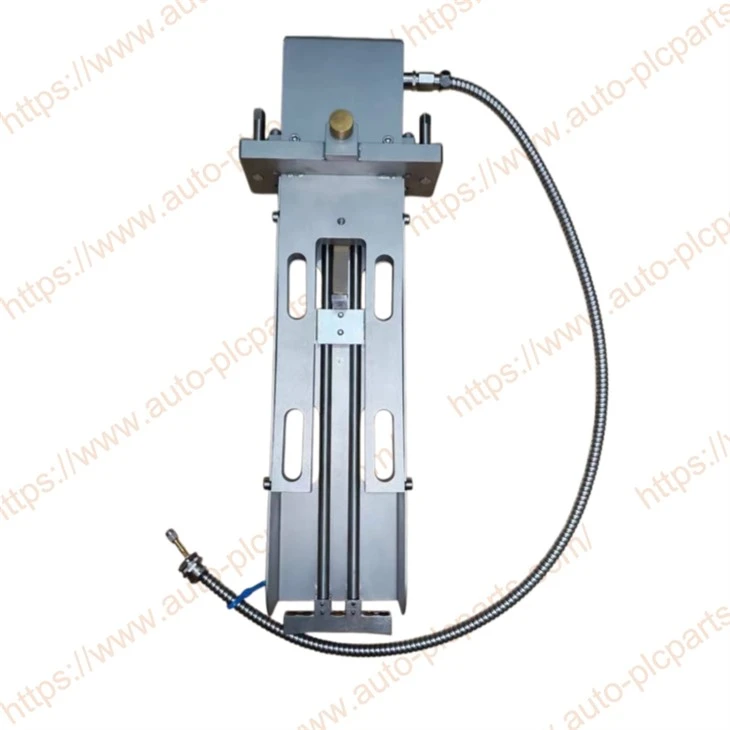
DP 243 is a pendulum-type displacement measurement probe that utilizes the non-contact eddy current measurement principle. It is designed based on the TQ402 sensing technology and is used for low-frequency vibration, structural displacement, and condition monitoring of large rotating machinery. This product detects the relative displacement between the pendulum mechanism and the target, converting mechanical motion into continuous measurement signals. It is combined with the IQS 450 Signal Conditioner to form a complete measurement chain, suitable for online monitoring systems of equipment such as steam turbines, hydro turbines, gas turbines, generators, and compressors. It supports a maximum working temperature of +200°C and can be configured with different measurement ranges, cable lengths, and transmission methods according to on-site requirements, meeting various industrial application scenarios.
For equipment maintenance and procurement personnel, DP 243 focuses more on system compatibility, long-term operational capability, and installation flexibility. The product supports two signal transmission methods: 2-wire (up to 1000 m) and 3-wire (up to 200 m), and can be integrated with the VM600 system and other mechanical protection and condition monitoring platforms. We can provide original model supply, model selection support, complete order code confirmation, global logistics distribution, and after-sales technical services. We also assist customers in confirming the matching IQS 450, EA402 extension cables and related accessories, helping to shorten the procurement cycle and reduce project risks caused by incorrect model matching.

Technical Specifications
| Product Name | Pendulum Probe DP 243 |
| Product Type | Pendulum Displacement Probe |
| Measuring Principle | Non-contact Eddy Current Measurement |
| Sensor Technology | Based on TQ 402 Proximity Sensor |
| Signal Conditioner | IQS 450 Series (Required) |
| Measurement Range | Available on Request |
| Operating Temperature | Up to +200°C |
| Mounting Position | Vertical (±30°, Head Up) |
| Housing Material | Stainless Steel |
| Air Gap | 1.0–1.5 mm (Max. 1.5 mm) |
| Shaft Collar Width | 7 mm (Nominal) |
| Integral Cable Diameter | 3.6 mm FEP Coaxial Cable |
| System Cable Length | 5 m / 10 m |
| Transmission Method | 2-Wire or 3-Wire |
| Maximum 2-Wire Distance | Up to 1000 m |
| Maximum 3-Wire Distance | Up to 200 m |
| 2-Wire Output | Current Modulation |
| 3-Wire Output | Voltage Modulation |
| Optional Extension Cable | EA 402 |
| Optional Galvanic Separator | GSI 124 |
| Probe Configuration | Single TQ402 or Triple TQ402 |
| Weight | Approx 2 kg |
| HS code | 8414909090 |
| Application | Machinery Protection & Condition Monitoring |
Key Features
Non-contact Measurement Technology
DP 243 adopts the non-contact eddy current measurement principle. It achieves continuous measurement through the relative displacement between the pendulum mechanism and the target, avoiding wear caused by mechanical contact. It is suitable for rotating mechanical equipment that requires long-term online monitoring.
Based on TQ402 Sensor Technology
The probe adopts the Vibro-Meter TQ402 displacement sensing technology and can be paired with the IQS450 Signal Conditioner to form a complete measurement system, providing continuous displacement signals for mechanical protection systems and condition monitoring systems.
Suitable for Long-distance Signal Transmission
Based on the on-site installation conditions, two-wire or three-wire transmission schemes can be selected. The two-wire system can achieve a maximum transmission distance of up to 1000 meters, which is suitable for projects where the control room is far from the measurement points; the three-wire system has a maximum transmission distance of 200 meters and can be directly connected to most mechanical monitoring systems.
Configurable Measuring Range
DP243 supports customization of measurement range, pendulum size, and system length according to different equipment operating conditions, and can meet the installation requirements of power generation, oil and gas, chemical, and other industrial equipment.
High-temperature Industrial Application
The product is permitted to operate at a maximum temperature of +200°C. It features a stainless steel body structure and can be installed near high-temperature equipment such as steam turbines, gas turbines, and hydro turbines. It is suitable for continuous operation conditions.
Flexible System Configuration
Supports system lengths of 5 meters or 10 meters, and can be optionally equipped with EA402 extension cables, GSI124 isolators, and a three-probe redundant configuration, facilitating the combination and configuration according to different monitoring systems.
Working Principle
DP 243 adopts a measurement method combining a pendulum mechanism with electro-vortex displacement measurement technology. By detecting the position changes of the pendulum relative to the target, it enables continuous monitoring of the low-frequency displacement and structural vibration of the equipment. The entire measurement process does not require mechanical contact, which can reduce wear between the measurement components and the object being measured, while maintaining a stable signal output.
A TQ402 eddy current displacement sensor is installed inside the probe. This sensor is fixed at the top of the pendulum and continuously monitors the relative distance between it and the target. When the equipment tilts, swings, or undergoes low-frequency vibration, the pendulum remains relatively stable due to gravity, while the mounting base moves along with the equipment, resulting in displacement changes between the two. The TQ402 converts these displacement changes into electrical signals and transmits them to the IQS450 signal conditioner for high-frequency excitation, demodulation, and signal processing. The processed signals can be output to the mechanical protection system, status monitoring system, PLC, or DCS to achieve real-time monitoring of the equipment's operating status.
Depending on the distance between the on-site control room and the equipment, different signal transmission methods can be adopted. When the measurement points are far apart, a two-wire current modulation method can be used, with the longest transmission distance reaching up to 1000 meters. This method can also be converted into a voltage signal through the GSI124 isolator for use by the monitoring system. For installation environments with shorter distances, a three-wire voltage modulation method can be employed, directly connected to most mechanical monitoring systems, without the need for additional conversion equipment.
Because DP243 supports various measurement ranges, system lengths, and probe configurations, it can be customized according to the actual working conditions and is widely applied in basic vibration monitoring, structural displacement monitoring, and equipment condition analysis of large rotating machinery such as steam turbines, hydro turbines, gas turbines, compressors, generators, etc., providing continuous monitoring data for the mechanical protection system.
Installation Guide
 Before installing the DP 243 Pendulum Probe, it is necessary to confirm the probe model, signal output method, wiring form, and compatibility with the existing vibration monitoring system. Depending on the configuration, the DP 243 can adopt different signal transmission methods, including 2-wire current modulation output and 3-wire voltage modulation output. During installation, the correct connection method must be selected according to the input requirements of the on-site monitoring system.
Correct mechanical installation, electrical connection, and system configuration are crucial steps for ensuring the accuracy of vibration measurement data.
Step 1: Clean the installation surface
Step 2: Secure the Pendulum Probe DP 243. According to the equipment installation requirements, fix the DP 243 to the designated measurement position.
Step 3: Cable Arrangement. After the probe installation is completed, it is necessary to properly arrange the connecting cables.
Step 4: Electrical connection. The Pendulum Probe DP 243 can adopt different output methods depending on the different model configurations.
Step 5: After completing the mechanical installation and electrical connections, system debugging is required.
ORDERING INFORMATION
| PNR: VMD-DP243–A – B – C – D – E – F – G – H – I | |||
| --Measuring Range ( A ) |
-XX …+YY mm
|
XXYY
|
|
| --shaft collar diameter( B ) mm |
XXX mm
|
XXX
|
|
| --Length ( C ) = X3 |
XXX mm
|
XXX
|
|
| --Cable length ( D ) |
01
|
1 m
|
|
|
05
|
5 m
|
||
|
10
|
10 m
|
||
| --Extension Cable( E ) |
00
|
0 m
|
|
|
04
|
4 m
|
||
|
09
|
9 m
|
||
| --Protection Cable ( F ) |
00
|
none
|
|
|
01
|
BOA
|
||
| --System Length ( G ) |
05
|
5 m
|
|
|
10
|
10 m
|
||
| --Direction ( H ) |
A
|
Version A
|
|
|
B
|
Version B
|
||
| --Probe ( I ) |
1
|
1x TQ 402
|
|
|
3
|
3x TQ 402
|
||
FAQ
Q: What devices is the DP 243 Pendulum Probe mainly used for?
A: DP 243 is mainly used for vibration monitoring of industrial rotating machinery, including:
Steam turbine;
Gas turbine;
Generator;
Compressor;
Pump;
Large motor;
Industrial machinery.
Q: What is the working principle of DP 243?
A: DP 243 measures the vibration movements generated by the operation of the internal mechanical measurement structure, and converts the mechanical displacement changes into electrical signals for output.
After receiving the signal, the monitoring system can further analyze the operating status of the equipment and be used for mechanical condition assessment.
Q: What information needs to be confirmed before purchasing DP 243?
A: It is recommended to provide the following information before making the purchase:
Complete model;
Original equipment photo;
System model used;
Connection method of the probe;
Type of equipment used.
These pieces of information can help confirm the correct replacement model.
Q: Does DP 243 support international transportation?
A: Support international transportation services.
Based on the customer's location, the following arrangements can be made:
DHL;
FedEx;
UPS;
TNT;